From Pilots to Operating System
The conversation has shifted. Here's what the market is telling us — and what it means for your Microsoft investment.
The conversation has shifted. Here's what the market is telling us — and what it means for your Microsoft investment.
In April, we asked the question most organizations are quietly wrestling with: Why does AI still feel harder to scale than it should?
The answer wasn't ambition or technology. It was fluency — the organizational capability to move beyond isolated tools and toward a coherent AI strategy across Microsoft's integrated platform.
But there's a follow-on question that comes after fluency. One that leaders are raising as their pilots mature and their investments grow:
What comes after the pilot?
The answer converging across the industry is the same: orchestration.
What the Market Is Saying
The signal is consistent across the organizations shaping enterprise AI strategy right now.
KPMG, in a study of more than 1,400 senior executives, found that "real value comes not from individual AI use cases, but from intelligent, enterprise-wide orchestration." Most enterprises, they found, are optimized for single-point automation — not the end-to-end orchestration that agentic systems require.
Microsoft underscored the urgency just this week with Agent 365 reaching general availability — a unified control plane for governing AI agents wherever they run. Shadow AI is no longer theoretical. Governance at the orchestration layer is no longer optional.
"The shift in focus from output to orchestration will determine which enterprises realize the full value potential of AI."
The AI Operating System
This is the framework we introduced at the close of April's webinar — and the focus of our May conversation.
Think about what an operating system does for a computer: it doesn't replace the applications. It coordinates them. It manages resources, enforces rules, and creates a reliable foundation so everything built on top can function at its best.
That's what the AI Operating System does for your Microsoft environment.
It has four integrated layers:
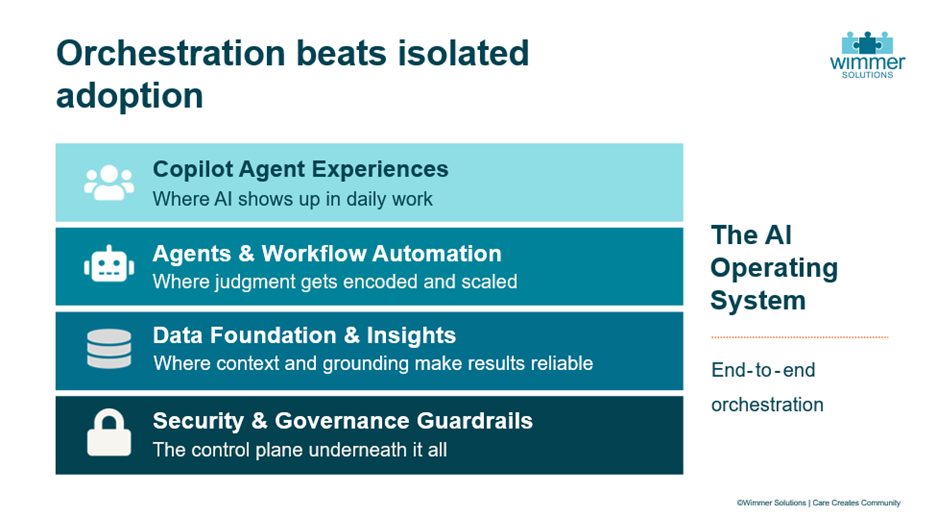
The power isn't in any single layer. It's in the integration. When Copilot experiences are grounded in real business data, outputs become reliable. When agents are governed by consistent guardrails, they can run autonomously. When workflows are designed around real scenarios, they compound value rather than create technical debt.
From the Field
The framework above isn't theoretical.
We saw it play out at a Fortune 500 global technology distributor that had every component of an AI strategy in place — except the orchestration to make them work together. link to case study AI-Driven Analytics & Lead Generation | Wimmer Solutions
The division's content and engagement data were managed in disconnected systems. Webinar registrations in one place. Survey responses in another. Lead routing held together by manual workflows that lagged days behind the events that triggered them. The team had Oracle Eloqua. They had Salesforce. They had AI and ML capabilities available to them. What they didn't have was the layer underneath that let those capabilities operate as a coordinated system.
We built that layer — an adaptive transcoder with embedded AI/ML that tags, normalizes, and routes incoming data in real time, with supervised learning that improves alongside the data itself.
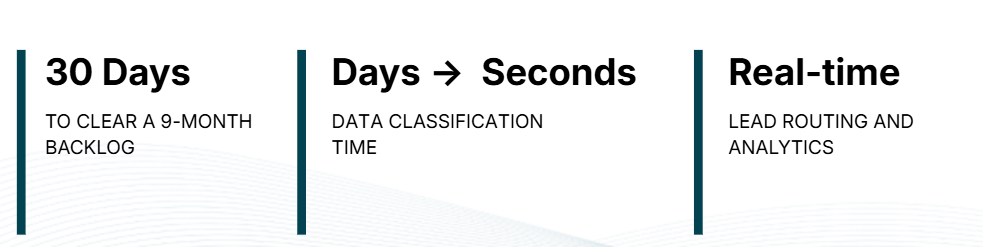
But the result that matters most for this conversation isn't the speed. It's that we embedded human-centered governance into the project from day one — because technology alone doesn't drive sustainable change, and an agent fleet without a control plane is a liability waiting to surface.
That's the AI Operating System in practice: integration, grounding, and governance treated as one coherent design problem, not three separate procurement decisions.
Which Agent Is Right for Which Person?
One of the most common questions we hear is: "We have Copilot Studio, Azure AI Foundry, and Microsoft 365 Copilot — which should we use, and for whom?"
Microsoft answered this directly in a platform update published last week. The decisioning comes down to persona:

This is what the Data Foundation & Insights layer of the AI Operating System makes possible: agents that don't just retrieve records, but understand your business. The bottleneck, as Microsoft's team put it, is no longer model access. It's business context. And Dataverse, now positioned as the agent data platform, is where that context lives.
Why this matters versus the alternatives
It would be a mistake to read this as a Microsoft-only story. AWS Bedrock AgentCore and Google Gemini Enterprise Agent Platform are both shipping serious agentic infrastructure, and Agent 365's new registry sync — which imports Bedrock and Gemini agents into a single inventory — is Microsoft's quiet acknowledgment that no enterprise will run on one stack alone. The model layer is converging. The orchestration primitives are converging. On raw capability, the gap is closing fast.
What's harder to replicate is where the work happens. For most enterprises, that's still Outlook, Teams, Excel, SharePoint, and the business data sitting in Dynamics 365 and Dataverse. An agent that reasons brilliantly but lives outside the day-to-day surfaces of work creates one more system to context-switch into — the opposite of what orchestration is supposed to deliver. The Microsoft advantage isn't the model. It's that the agent shows up inside the document the user is already writing, the meeting they're already in, and the record they're already updating, governed by the same identity and policy controls IT already runs.
That's the bet behind the AI Operating System framing: in an era when capability is becoming a commodity, business context becomes the moat. Bedrock and Gemini are close behind on the runtime. Microsoft is ahead on the surface area where work actually gets done.
The Question for Leaders
Gartner projects that 33 percent of enterprise software applications will include agentic AI by 2028 — up from less than 1 percent today. With 72 percent of organizations already running AI across multiple departments, coordination has become imperative.
The challenge has evolved from "can we deploy AI?" to "how do we coordinate what we've already deployed into something that compounds?"
Organizations that build their AI Operating System now — with intention, with governance, with a clear view of which Microsoft capabilities serve which personas — won't just close the gap between pilots and scale. They'll move to a position where the gap compounds in their favor.
Orchestration beats isolated adoption.
Join Us This Month: AI Fluency in Action — May Webinar
A live conversation about building the AI Operating System inside your Microsoft environment — from the agent types that fit your teams, to the data foundation that makes them reliable, to the governance model that makes them trustworthy at scale. Designed for CIOs, COOs, technology leaders, and business executives who are past the curiosity stage and ready to build something that scales.
Register for the May Webinar →