From Solutions to Performance: Embedding AI into the Business Operating Model
This gap between AI activity and business value is what McKinsey describes as the adoption paradox: companies are using AI but not transforming with it. The result is familiar with dozens of pilots, limited ROI, and a growing divide between AI leaders and laggards.
This gap between AI activity and business value is what McKinsey describes as the adoption paradox: companies are using AI but not transforming with it. The result is familiar with dozens of pilots, limited ROI, and a growing divide between AI leaders and laggards.
So, what separates solutions from performance?
- Solutions are isolated tools or pilots—chatbots, forecasting models, or automations—designed for individual use cases.
- Performance is measurable, enterprise‑wide impact: faster cycle times, higher productivity, improved customer outcomes, and stronger financial results.
The challenge is that many organizations mistake deploying AI solutions for achieving AI performance. They implement tools without embedding them into how the business actually operates. As a result, outcomes remain flat—even as AI activity increases.
To move from solutions to performance, organizations must embed AI into their business operating model—the roles, processes, systems, governance, and decision structures that drive daily execution.
That shift requires five deliberate moves:
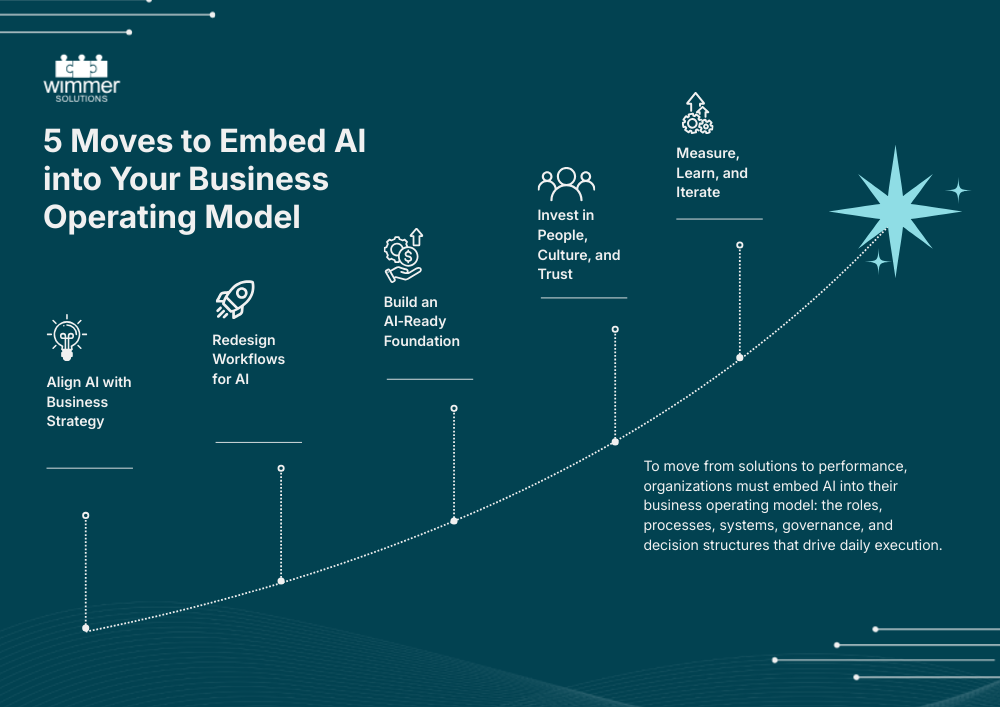
1. Align AI with Business Strategy
High‑performing organizations use AI to drive growth, differentiation, and resilience—not just efficiency. Every AI initiative should be explicitly tied to a business outcome, strategic priority, and accountable owner.
2. Redesign Workflows for AI
Rather than layering AI onto legacy processes, leaders must rethink how work gets done. The most effective question isn’t “Where can we automate?” but “If we designed this process today with AI in mind, what would it look like?”
3. Build an AI‑Ready Foundation
Scalable AI depends on strong data, integrated platforms, and clear governance. Fragmented systems and inconsistent data will stall even the most advanced models. AI performance is constrained by the operating environment in which it runs.
4. Invest in People, Culture, and Trust
AI success is not primarily a technology challenge—it’s an organizational one. Upskilling, leadership alignment, and change management are essential. Employees must understand how to work with AI and trust the decision-making process.
5. Measure, Learn, and Iterate
AI is not a one‑time deployment. It is a continuously evolving capability. Organizations must track adoption and impact, gather feedback, and refine both technology and behavior over time.
This is where Operational Change Management (OCM) becomes indispensable.
OCM is the discipline that ensures AI is not just deployed, but operationalized. It translates strategy into new ways of working by aligning leadership, reshaping behaviors, updating processes, and reinforcing accountability. Without OCM, even the most advanced AI tools will remain underutilized—or abandoned.
Leading organizations are already making this shift. The World Economic Forum’s 2026 research highlights companies embedding AI into enterprise strategy, redesigning work around human‑AI collaboration, and strengthening data and governance foundations. BCG’s research shows that “future‑built” companies—those with AI‑first operating models—achieve 1.7x higher revenue growth and 3.6x higher shareholder returns.
The implication is clear: AI is no longer a technical experiment. It is a business transformation mandate.
To lead in this next era, executives must:
- Audit their AI portfolio and sunset dead‑end pilots
- Embed AI into core workflows and decision‑making
- Invest in operational change management and workforce enablement
- Establish governance, measurement, and feedback loops to scale what works
The next wave of competitive advantage will belong not to those who deploy the most AI solutions, but to those who treat AI as a system for performance.
Ready to Move Beyond Pilots?
Explore how Wimmer Solutions, in partnership with Microsoft, is enabling responsible, scalable, and secure solutions tailored for today’s business challenges in our upcoming on February 9, 2026.

Our experts will share:
- Why most AI initiatives fail and how to avoid common pitfalls
- What the leaders do differently to accelerate ROI
- Practical steps to build AI fluency across your organization
This isn’t just theory. You’ll gain actionable insights from real-world success stories and learn how to position your business for measurable impact.
Furthermore, if you want a deeper understanding of whether your operating model is ready for agents at scale, our Agent Readiness Assessment can help leaders like you on the following:
- Identify where AI and agents are delivering value today—and where they are stalled
- Evaluate readiness across strategy, workflows, data, governance, and change management
- Pinpoint the highest‑impact opportunities to move from experimentation to execution
- Establish a clear, actionable roadmap from pilots to scalable agentic systems
The assessment provides an executive‑level view of how prepared your organization is to embed AI into daily operations—and what it will take to turn solutions into sustained performance.
👉 Let's talk about how our Agent Readiness Assessment can help you progress toward an AI‑ready operating model. Book a quick consult here.
About the author: Justin Smyth is a strategic technology leader with deep expertise in business transformation, Copilot governance, and Microsoft ecosystem integration. With 15+ years in enterprise solutions, digital strategy, and Microsoft delivery leadership, he specializes in aligning AI strategy with operational execution, enabling organizations to scale Copilot adoption through structured governance, telemetry, and persona-based enablement. Justin's work bridges client partner, solution architecture, and delivery oversight across Microsoft’s Customer Experience, Services, and Partner networks.